
The 5 email flows every Shopify store should have running
Flows are 5% of email sends but 41% of email revenue. The five every Shopify store needs, what each one should send and when, and how to tell they're working.
 Dair Rose Founder, Skynify · 7 min read
 - Flows were 5.3% of email sends but 41% of email revenue in Klaviyo's 2026 benchmarks.
- Start with welcome, abandoned cart and post-purchase, then add browse abandonment and win-back.
- Judge flows on revenue per recipient and orders, not on open rates.
On this page+
Email flows are automated messages that go out when a shopper does something specific: signs up, looks at a product, leaves a cart, places an order, or goes quiet. Once they're set up, they keep working without anyone pressing send.
They're also the cheapest revenue most stores will ever get, because you've already paid to bring these people to your site. This guide covers the five flows every Shopify store should have running, what each one should say and when, and how to tell whether yours are pulling their weight.
Why flows earn more than campaigns
Campaigns are the emails you send to your whole list, or a big part of it: a launch, a sale, a newsletter. Flows go to one person at a time, right after they did something, so they arrive while that shopper is still thinking about you.
That timing shows in the results. In Klaviyo's 2026 benchmarks, flows were just 5.3% of the emails brands sent, but they brought in 41% of email revenue. Each person who got a flow email brought in nearly 18 times as much as someone who got a campaign.
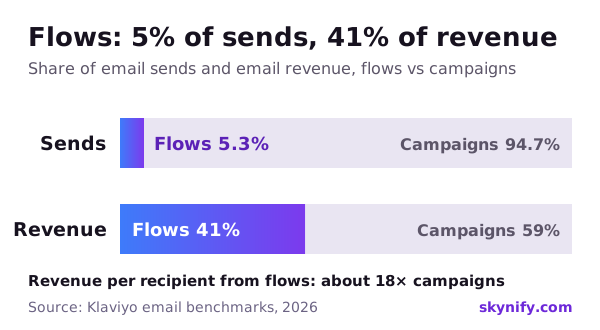
Share of email sends and email revenue across brands on Klaviyo. Source: Klaviyo email benchmarks, 2026.
Clicks tell the same story: Klaviyo puts a good click rate at 5.58% for flows, against 1.69% for campaigns. Campaigns still matter, since they're how you announce launches and sales. But if your flows aren't running, you're missing the emails that earn the most for the least work.
The five flows, and when each one sends
Every flow starts with something the shopper does. Here's the whole journey at a glance:
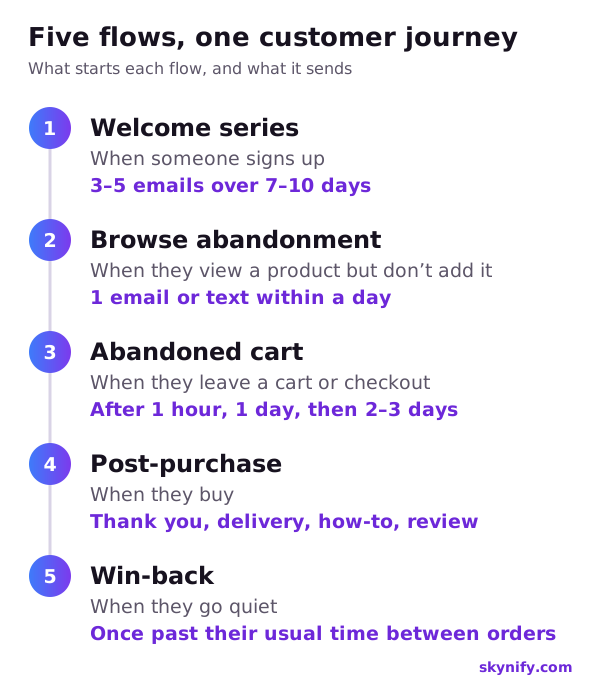
The timings are where we usually start. Your own results should decide where they end up.
We set up the first three for every client before anything else, because they catch shoppers when interest is highest: right after signing up, right after leaving a cart, and right after buying. Browse abandonment and win-back come next.
1. The welcome series
When someone joins your list, they're at their most interested. A welcome series of three to five emails over the first week or so should introduce your brand, show your bestsellers, answer common questions, and give them a reason to place a first order.
- Email 1, right away: thank them and deliver whatever you promised for signing up.
- Email 2: your story, and why your product is different.
- Email 3: reviews, customer photos and your bestsellers.
- Email 4: answers to the questions that stop people buying: shipping, returns, sizing, how long it lasts.
- Email 5: a friendly reminder that the offer is ending.
Two settings are easy to miss. Stop the series as soon as someone places an order. And give people who sign up after buying a different version, so a customer doesn't get a first-order discount the day after paying full price.
2. Abandoned cart
Someone added a product, got distracted, and left. A short sequence brings them back:
- After about an hour: a simple reminder with a photo of what they left.
- The next day: reviews and answers to common questions.
- Two or three days later: a last reminder, with a small incentive only if your margins allow it.
This is the flow that earns the most. In Klaviyo's 2026 report on abandoned cart flows, covering more than 110,000 brands, each person who received a cart email brought in $6.77 on average, and $13.70 for the top 10% of brands. That's the highest revenue per recipient of any flow (Klaviyo). To see what that could mean for your own store, try our abandoned cart calculator.
If you send cart reminders from Klaviyo or Omnisend, make sure Shopify's own abandoned checkout email is switched off, or shoppers will get two.
3. Post-purchase
After the first order, thank the customer, set expectations for delivery, and help them get the most out of the product. This is where a one-time buyer starts turning into a repeat customer.
- Right after the order: thank you, and what happens next.
- Around delivery: how to use it, set it up or look after it.
- A week or two after delivery: ask for a review while the product is still new to them.
- Before they'd usually reorder: a reminder, a refill or something that goes with what they bought.
4. Browse abandonment
Some shoppers look at a product and leave without adding anything to their cart. If they're already on your list, your email platform can recognize them and send one short email, or a text, within a day: the product they looked at, a few reviews, and an easy way back.
Keep it light. They showed interest, not intent, so this isn't the place for a discount. And because it only reaches shoppers your platform can identify, such as subscribers and past customers, a good sign-up form makes this flow work better too.
5. Win-back
Customers who haven't bought in a while need a reason to come back. Start the flow once someone is past the usual time between orders for your store. Shopify's customer reports show how often people come back, and Klaviyo can predict each customer's next order date once you have enough order history.
Show them what's new, remind them what they liked, and if they still don't respond, ask whether they want to keep hearing from you. Then stop emailing the ones who don't answer.
That last step protects everything else you send. Gmail requires bulk senders to keep spam complaints below 0.3% and to offer one-click unsubscribe (Google). Emailing people who stopped reading months ago pushes complaints up and can send your emails to spam for everyone.
Where text messages fit
Texts get read quickly, which makes them good for things that can't wait: an abandoned cart, a shipping update, early access to a sale. Use them for the moments that matter, not as a copy of every email.
Two rules. Texts need their own permission: someone who joined your email list hasn't agreed to texts. And every text should be worth the interruption. Klaviyo and Omnisend, the two platforms we build in, can both send texts from the same flows as your emails, so you don't need a separate tool.
How to tell whether your flows are working
Open rates stopped being reliable in 2021, when Apple Mail started loading emails automatically to protect people's privacy, which counts many unread emails as opened. Look at these instead:
- Revenue per recipient: what each person who got the flow brought in. It's the fairest way to compare one flow, or one version of an email, with another.
- Placed order rate: the share of people who got the flow and then ordered.
- Click rate: Klaviyo's benchmark for a good flow is 5.58%, and the top 10% of brands reach about 10.5%.
- Flows' share of your email revenue: across brands on Klaviyo, flows bring in about 41%. If yours bring in much less, some are probably missing, switched off or too thin.
Once a month, go through each flow as a shopper would: sign up with a test email, leave a cart, and check that every email arrives, every link works, and nobody gets two flows at once.
What this looks like for real brands
Flows rarely work alone. For Haven Sleep Co, a Canadian mattress brand, we rebuilt the ads and built new email flows, so shoppers who arrived from an ad kept hearing from Haven until they were ready to buy. Monthly revenue went from $20K to $500K in six months.
For Soul Comfort, we rebuilt the email and SMS alongside new landing pages and new ads. Monthly revenue grew from $21K to $105K in four months.
Get them live this month
You don't need perfect copy or fancy design to start. A simple version of each flow, live this month, will beat a perfect version still sitting in drafts next quarter. In order:
- Welcome series: three emails is enough to start.
- Abandoned cart: one email after an hour, then add the other two.
- Post-purchase: a thank-you and a review request.
- Browse abandonment: one email.
- Win-back: one email, plus the "still want to hear from us?" email.
Then improve one flow a month, starting with the one the most people go through. To see what repeat orders are worth to your store, try our customer lifetime value calculator, and if your ads look good but profit doesn't, read why a great ROAS can still lose money.
Questions and answers
A campaign goes to your list, or part of it, at a time you choose, like a sale announcement. A flow goes to one person at a time, triggered by something they did: signing up, leaving a cart or buying. In Klaviyo's 2026 benchmarks, flows were 5.3% of emails sent but 41% of email revenue.
Three to five over the first week or so: deliver the sign-up offer, tell your story, show reviews and bestsellers, answer common questions, and remind people before the offer ends. Stop the series as soon as someone orders.
Our starting point is about an hour after the cart is left, again the next day, and a last reminder two or three days later. Test the timing for your own store from there.
Klaviyo puts a good click rate at 5.58% for flows, against 1.69% for campaigns, and the top 10% of brands reach about 10.5% for flows. Judge flows on clicks, orders and revenue per recipient rather than opens, which Apple Mail inflates.
No. Klaviyo and Omnisend, the two platforms we build in, both run all five flows, texts included. Whichever tool you use, make sure only one of them sends your abandoned cart reminders, so shoppers don't get two.

Founder of Skynify. Nine years in e-commerce and 50+ Shopify brands scaled, from first-time founders to Tuff Crowd.