
How much should you discount for Black Friday?
Most stores copy the 30% everyone else runs. Here's how to set a Black Friday discount your margins and ads can actually pay for, with 2025 data.
 Dair Rose Founder, Skynify · 9 min read
 - Big US retailers peaked between 17% and 31% off in 2025. Furniture topped out at 19%.
- Your ceiling comes from your margin and your ad costs: at a 3× ROAS, our example store can't go past about 14%.
- Spend-more-save-more tiers, gifts, bundles and financing often beat a deeper % off.
On this page+
Every October, the same question comes up on our strategy calls: how much should we take off for Black Friday? Usually the store has already picked a number. It's 30%, because that's what everyone else seems to do.
Shoppers do expect a deal. Shopify's own advice puts it plainly: most people expect a Black Friday discount of up to 30%. But copying someone else's discount means copying their margins too, and that's how stores end up with record revenue in November and a smaller bank balance in December.
Here's how to set a number your store can actually afford.
The short answer
Your discount should come from two numbers, not from what competitors run:
- What each order leaves you after costs: product, shipping, payment fees and returns. That's your margin.
- What your ads will cost per order during the sale. That's your ROAS.
Take our example store: a $100 order that leaves $41.80 after costs. Without ads, it could survive a discount of up to about 45%. But if ads bring in the sale at a 3× ROAS, the most it can give away and still make money on those orders is about 14%. At 4×, about 25%.
So for most Shopify brands the answer isn't 30% across the board. It's a smaller discount on your bestsellers, a deeper one only on stock you need to clear, and a better offer instead of a bigger percentage.
Our rule of thumb: know your margins, ad costs included, before you choose a number. Ads often cost less per sale on Black Friday, but you're also up against every other brand for attention. A smaller margin can still make you more money if the extra orders come, so do the math first, then decide.
What shoppers expect, and what big retailers actually gave
Adobe tracks prices across major US online retailers. At Cyber Monday 2025, the deepest discounts by category looked like this:
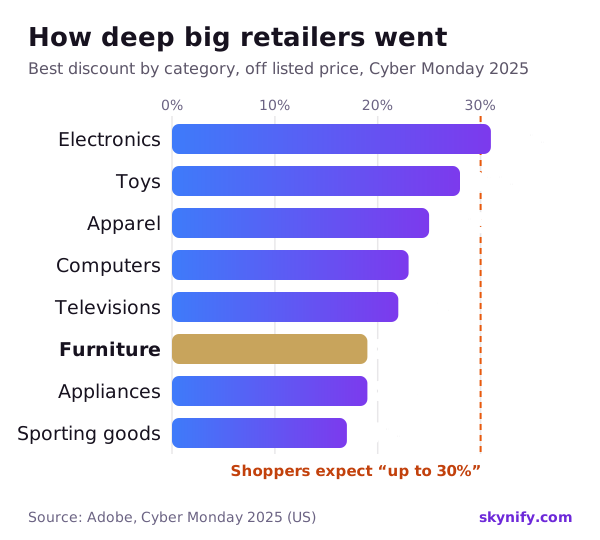
Peak discount off the listed price on major US retail sites, as of Cyber Monday 2025. Source: Adobe.
Two things stand out. First, these are peak discounts: the best deal in each category, from retailers with far more buying power than most Shopify brands. Plenty of products sold for less off. Second, the range is wide. Electronics hit 31%, but furniture topped out at 19% and sporting goods at 17% (Adobe, December 2025).
In other words, 30% isn't a rule. It's the top of the range in a few categories.
Why a discount needs so many extra orders
A discount comes straight out of your margin. Your product, shipping and packing cost the same whether you charge $100 or $75, so the profit on each order shrinks much faster than the price does.
The math fits on one line: orders needed = margin ÷ (margin − discount).
- At a 50% margin, 20% off needs 1.7× the orders just to make the same profit.
- At a 40% margin, 20% off needs twice the orders, and 25% off needs 2.7×.
- At a 30% margin, a 30% discount can never pay, however many orders you get.
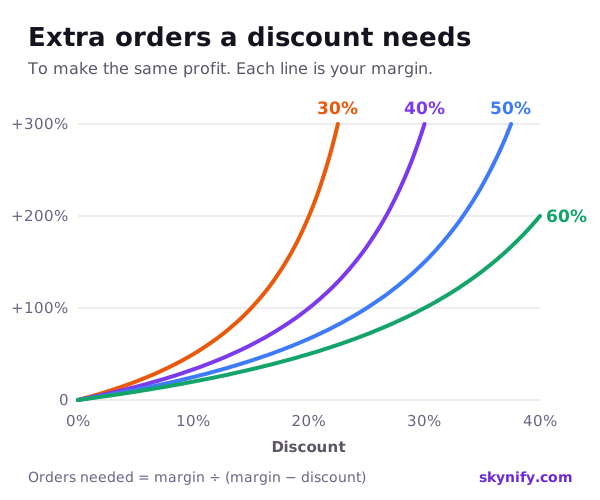
Assumes each order costs you the same at the lower price. Margin is what an order leaves after product, shipping, fees and returns.
If your discount needs twice the orders to break even, ask yourself honestly: will Black Friday double your sales?
Then add what your ads cost
During the sale, ads are usually your biggest cost per order, and Black Friday is the most expensive week of the year to buy attention. One analysis of large US Meta ad accounts found CPMs (the price of 1,000 ad views) were 57% higher on Black Friday 2025 than in October. The same data showed cost per purchase falling 42%, because shoppers converted at more than three times their October rate (Biddyco).
So ads can still pay on Black Friday, but only if your discount leaves enough margin to cover them. If ROAS versus profit is new to you, start with why a great ROAS can still lose money. Here's the example store again:
- At full price: a $100 order leaves $41.80. With ads at a 3× ROAS, each ad-driven sale costs $33.33 in ads, so you keep $8.47.
- At 25% off: the order is $75 and leaves $18.78 (fees and returns shrink with the price; product and shipping don't). The ads still cost $25 a sale at 3×, so you lose $6.23 on every order.
That's why the ROAS you can realistically expect during the sale matters as much as your margin:
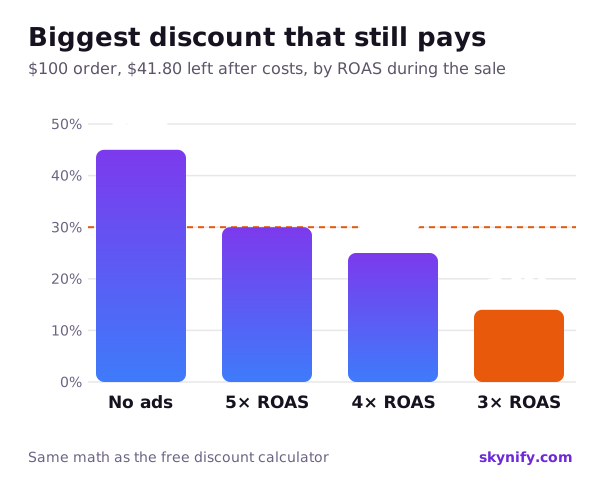
Product ($35) and shipping ($15) cost the same at any price; fees (2.9% + $0.30) and returns (5%) shrink with it. A 30% sale at a 3× ROAS loses $9.16 on every ad-driven order.
Want this for your own store? Our free discount break-even calculator opens with this example store filled in. Swap in your numbers and it shows how many more orders you need, the biggest discount you can afford and the ROAS your ads need during the sale. Not sure what your margin is? The break-even ROAS calculator works it out first.
Set the discount by product, not across the whole store
A single sitewide percentage treats your best product and your slowest one the same. They aren't.
- Bestsellers that sell fine at full price: keep the discount small, or skip it and add a gift or bundle instead. You'd sell many of these anyway.
- Slow movers and overstock: this is where a deeper discount makes sense. Turning stuck stock into cash before January is a different calculation from profit per order.
- Low-margin products: leave them out of the sale. If the calculator says a product can't afford any discount at your expected ROAS, don't put it in your ads.
- Discount stacking: check which of your discounts can combine. In Shopify each discount has its own combination settings, so a welcome code or an abandoned-cart code can quietly stack on top of your sale price. Make sure that only happens when you mean it to.
Better ways to give value than a bigger percentage
You don't have to win Black Friday on the size of the number. These offers often feel just as generous and cost you less:
| Offer | What it costs you | Why it works |
|---|---|---|
| Spend more, save more (for example $20 off $150, $50 off $300) | The discount, but only on bigger orders | Raises the average order, so the discount pays for itself |
| Free gift with purchase | The gift at your cost, not its retail price | Feels generous and keeps your full price intact |
| Bundles | A modest discount on a set | Moves more products per order and per ad click |
| Free shipping above a threshold | Your shipping cost on qualifying orders | Takes away a surprise cost at checkout |
| Early access for subscribers | Nothing extra | Rewards your list, and grows it in the weeks before the sale |
| 0% financing or monthly payments | The provider's fee | Makes a big ticket feel small: a $2,000 sofa is about $83 a month over 24 months |
On a $100 average order, a "$20 off $150" tier works out to about 13% off a bigger order, instead of 20% off the order you'd have got anyway.
For big-ticket stores, lower the barrier, not the price
Furniture and mattress stores play a different game. Nobody buys a $3,000 sofa on impulse because it's 30% off, and even the biggest US retailers' furniture discounts peaked at 19% in 2025. What moves big carts is making the decision easier: monthly payments, delivery included above a threshold, and photos and reviews that answer "will this look right in my room?" before the sale starts.
For a high-end furniture brand, we usually advise against a straight discount at all: it lowers how customers see the brand. Bundles work better, like a bed frame with sheets at a package price, or a set built around stock you have too much of. Or give a benefit instead of cutting the price, such as free white-glove delivery. We go deeper on selling furniture online on our furniture and home brands page.
When it's fine to skip the sitewide sale
Not every brand needs a Black Friday discount. If your margins are thin, or your brand depends on full-price positioning, you can still show up without cutting prices: a gift with every order, early access for your email list, a limited bundle, or a donation to a cause. Patagonia's "Don't Buy This Jacket" ad ran on Black Friday in 2011, and it's still the best-known example of a brand turning the day into something other than a sale.
The one thing to avoid is going quiet. It's the busiest shopping weekend of the year: Shopify stores alone sold a record $14.6 billion over Black Friday–Cyber Monday 2025. Have something to offer, even if it isn't a percentage.
After the sale, check who you won
A big Black Friday can hide a weak one. Before you plan next year's discount, look at the customers it brought in:
- How many were new, and how many would have bought at full price anyway?
- How many came back for a second order within 60 to 90 days?
- What did your Black Friday customers spend over the next six months, compared with everyone else?
Studies on whether Black Friday customers come back point in both directions, so your own numbers are the only ones that count. If they mostly buy once, a deeper discount next year just buys more one-time customers. If they come back, you can afford to pay more to win them, and our customer lifetime value calculator shows how much.
What we see with our clients
The right offer depends on who's buying. One of our clients sells almost entirely to new customers: about 98% of their buyers have never ordered from them before. For them, simply relaunching their current offer as their Black Friday deal has worked for years, because nearly everyone who sees it is seeing it for the first time.
Other offers worth trying:
- Free shipping for the weekend, if you don't normally offer it.
- Buy one, get the second at 50% off, or free if your margins allow it.
- A bundle or a gift instead of a bigger percentage.
Shopify's built-in discounts handle all of these: buy X get Y, free shipping and amount-off discounts. And you don't have to guess. Test two offers against each other in your ads or on your store in the weeks before the sale (our A/B test calculator tells you when a result is real), or simply ask your followers on Instagram which offer they'd want.
Before you set your discount: a 10-minute checklist
- Work out what an order leaves you after costs for your top 10 products.
- Decide the ROAS you can realistically expect during the sale. Last year's Black Friday week is the best guide.
- Find the biggest discount each product can afford with the discount calculator.
- Choose the offer: tiers, a gift, a bundle, financing or a straight discount.
- Check which discounts can combine in Shopify.
- Plan what happens after the sale, so new customers get a reason to come back.
If you'd like a second pair of eyes on your Black Friday offer, that's exactly what our strategy calls are for.
Questions and answers
Only if your margins and ad costs can pay for it. Shoppers expect up to about 30%, but the biggest US retailers' deepest discounts ranged from 17% to 31% by category in 2025, and furniture topped out at 19%. Work out what an order leaves you at 30% off, after product, shipping, fees and ads, before you commit.
There isn't one number. Adobe's data on major US retailers showed peak discounts from 17% for sporting goods to 31% for electronics at Cyber Monday 2025, with furniture and appliances at 19%. Those are the deepest deals of the season, so plenty of products sold for less off.
Often not as a straight discount. Cutting prices can lower how customers see a premium brand. Bundles, a gift with purchase, early access for subscribers or a benefit such as free white-glove delivery give real value without touching the price.
Spend-more-save-more tiers, free shipping above a threshold, bundles, a free gift, early access for your list, or monthly payments. They often feel just as generous and cost you less than a deeper discount, especially on big-ticket items.
Create a Buy X get Y discount: choose what customers buy, what they get, and the discount on it, either a percentage or free. Then test it in a real cart before the sale, and check which of your other discounts it can combine with.
If you don't normally, it's one of the strongest offers you can make: extra costs like shipping are the top reason shoppers abandon checkout, according to the Baymard Institute. Setting it above an order value also gives people a reason to add more to their cart.

Founder of Skynify. Nine years in e-commerce and 50+ Shopify brands scaled, from first-time founders to Tuff Crowd.